Bo Peng, Sahin Kaya Ozdemir, Fuchuan Lei, Faraz Monifi, Mariagiovanna Gianfreda, Gui Lu Long, Shanhui Fan, Franco Nori, Carl M. Bender, Lan Yang
Optical systems combining balanced loss and gain profiles provide a unique platform to implement classical analogues of quantum systems described by non-Hermitian parity-time- (PT-) symmetric Hamiltonians and to originate new synthetic materials with novel properties. To date, experimental works on PT-symmetric optical systems have been limited to waveguides in which resonances do not play a role. Here we report the first demonstration of PT-symmetry breaking in optical resonator systems by using two directly coupled on-chip optical whispering-gallery-mode (WGM) microtoroid silica resonators. Gain in one of the resonators is provided by optically pumping Erbium (Er3+) ions embedded in the silica matrix; the other resonator exhibits passive loss. The coupling strength between the resonators is adjusted by using nanopositioning stages to tune their distance. We have observed reciprocal behavior of the PT-symmetric system in the linear regime, as well as a transition to nonreciprocity in the PT symmetry-breaking phase transition due to the significant enhancement of nonlinearity in the broken-symmetry phase. Our results represent a significant advance towards a new generation of synthetic optical systems enabling on-chip manipulation and control of light propagation.
http://arxiv.org/abs/1308.4564
Optics (physics.optics); Materials Science (cond-mat.mtrl-sci); Mathematical Physics (math-ph); Classical Physics (physics.class-ph); Quantum Physics (quant-ph)
Chao Zheng, Liang Hao, Gui Lu Long
Masillo [1] commented on our manuscript [2] “Observation of a Fast Evolution in a Parity-time-symmetric System”, pointing out a contradiction of our work with Ref.[3]. In this reply, we pointed out there is no disagreement between Masillo’s comment and our work in Ref. [2]. The efficiency cost pointed out in Ref.\cite{masillo} exists, namely to obtain the PT-symmetric hamiltonian evolution, one has to make a measurement on the auxiliary qubit and the auxiliary qubit is at state \(\left|0\right \rangle\) only probabilistically. This is reflected in the amplitude of the spectrum in the NMR quantum simulation. As a result, we made a small modification in a new version of the Ref. [2], and Fig. 2 of Ref.[2] has been replaced by spectra of two different \(\alpha\)’s in order to illustrate this fact.
http://arxiv.org/abs/1106.1848
Quantum Physics (quant-ph)
Chao Zheng, Liang Hao, Gui Lu Long
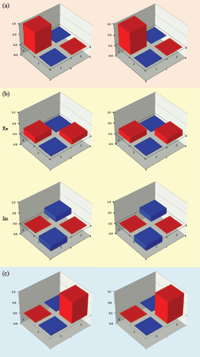 To find and realize the optimal evolution between two states is significant both in theory and application. In quantum mechanics, the minimal evolution is bounded by the gap between the largest and smallest eigenvalue of the Hamiltonian. In the parity-time-symmetric(PT-symmetric) Hamiltonian theory, it was predicted that the optimized evolution time can be reduced drastically comparing to the bound in the Hermitian case, and can become even zero. In this Letter, we report the experimental observation of the fast evolution of a PT-symmetric Hamiltonian in an nuclear magnetic resonance (NMR) quantum system. The experimental results demonstrate that the PT-symmetric Hamiltonian can indeed evolve much faster than that in a quantum system, and time it takes can be arbitrary close to zero.
http://arxiv.org/abs/1105.6157
Quantum Physics (quant-ph)