Samuel Kalish, Zin Lin, Tsampikos Kottos
The scattering properties of randomly layered optical media with \({\cal PT}\)-symmetric index of refraction are studied using the transfer-matrix method. We find that the transmitance decays exponentially as a function of the system size, with an enhanced rate \(\xi_{\gamma}(W)^{-1}=\xi_0(W)^{-1}+\xi_{\gamma} (0)^{-1}\), where \(\xi_0(W)\) is the localization length of the equivalent passive random medium and \(\xi_{\gamma}(0)\) is the attenuation/amplification length of the corresponding perfect system with a \({\cal PT}\)-symmetric refraction index profile. While transmitance processes are reciprocal to left and right incident waves, the reflectance is enhanced from one side and is inversely suppressed from the other, thus allowing such \({\cal PT}\)-symmetric random media to act as unidirectional coherent absorbers.
http://arxiv.org/abs/1205.1849
Optics (physics.optics)
Zin Lin, Joseph Schindler, Fred M. Ellis, Tsampikos Kottos
We investigate experimentally parity-time \({\cal PT}\) symmetric scattering using \(LRC\) circuits in an inductively coupled \({\cal PT}\)- symmetric pair connected to transmission line leads. In the single-lead case, the \({\cal PT}\)-symmetric circuit acts as a simple dual device – an amplifier or an absorber depending on the orientation of the lead. When a second lead is attached, the system exhibits unidirectional transparency for some characteristic frequencies. This non-reciprocal behavior is a consequence of generalized (non-unitary) conservation relations satisfied by the scattering matrix.
http://arxiv.org/abs/1205.2176
Mesoscale and Nanoscale Physics (cond-mat.mes-hall)
 Zin Lin, Hamidreza Ramezani, Toni Eichelkraut, Tsampikos Kottos, Hui Cao, Demetrios N. Christodoulides
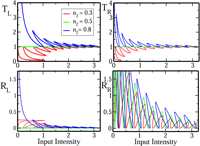
We show that parity-time (PT) symmetric Bragg periodic structures, near the spontaneous PT – symmetry breaking point, can act as unidirectional invisible media. In this regime, the re flection from one end is diminished while it is enhanced from the other. At the same time the transmission coefficient and phase, are indistinguishable from those expected in the absence of a grating. The phenomenon is robust even in the presence of Kerr non-linearities, and it can also eff?ectively suppress optical bistabilities.
http://arxiv.org/abs/1108.2493
Optics (physics.optics)