Hamidreza Ramezani, D. N. Christodoulides, V. Kovanis, I. Vitebskiy, Tsampikos Kottos
We show that complex PT-symmetric photonic lattices can lead to a new class of self-imaging Talbot effects. For this to occur, we find that the input field pattern, has to respect specific periodicities which are dictated by the symmetries of the system. While at the spontaneous PT-symmetry breaking point, the image revivals occur at Talbot lengths governed by the characteristics of the passive lattice, at the exact phase it depends on the gain and loss parameter thus allowing one to control the imaging process.
http://arxiv.org/abs/1209.2349
Optics (physics.optics); Other Condensed Matter (cond-mat.other); Quantum Physics (quant-ph)
J. Schindler, Z. Lin, J. M. Lee, Hamidreza Ramezani, F. M. Ellis, Tsampikos Kottos
We show both theoretically and experimentally that a pair of inductively coupled active LRC circuits (dimer), one with amplification and another with an equivalent amount of attenuation, display all the features which characterize a wide class of non-Hermitian systems which commute with the joint parity-time PT operator: typical normal modes, temporal evolution, and scattering processes. Utilizing a Liouvilian formulation, we can define an underlying PT-symmetric Hamiltonian, which provides important insight for understanding the behavior of the system. When the PT-dimer is coupled to transmission lines, the resulting scattering signal reveals novel features which reflect the PT-symmetry of the scattering target. Specifically we show that the device can show two different behaviors simultaneously, an amplifier or an absorber, depending on the direction and phase relation of the interrogating waves. Having an exact theory, and due to its relative experimental simplicity, PT-symmetric electronics offers new insights into the properties of PT-symmetric systems which are at the forefront of the research in mathematical physics and related fields.
http://arxiv.org/abs/1209.2347
Other Condensed Matter (cond-mat.other); Optics (physics.optics); Quantum Physics (quant-ph)
Hamidreza Ramezani, J. Schindler, F. M. Ellis, Uwe Guenther, Tsampikos Kottos
The beat time \({\tau}_{fpt}\) associated with the energy transfer between two coupled oscillators is dictated by the bandwidth theorem which sets a lower bound \({\tau}_{fpt}\sim 1/{\delta}{\omega}\). We show, both experimentally and theoretically, that two coupled active LRC electrical oscillators with parity-time (PT) symmetry, bypass the lower bound imposed by the bandwidth theorem, reducing the beat time to zero while retaining a real valued spectrum and fixed eigenfrequency difference \(\delta\omega\). Our results foster new design strategies which lead to (stable) pseudo-unitary wave evolution, and may allow for ultrafast computation, telecommunication, and signal processing.
http://arxiv.org/abs/1205.1847
Classical Physics (physics.class-ph)
Hamidreza Ramezani, Tsampikos Kottos, Vassilios Kovanis, Demetrios N. Christodoulides
We theoretically investigate the flow of electromagnetic waves in complex honeycomb photonic lattices with local PT symmetries. Such PT structure is introduced via a judicious arrangement of gain or loss across the honeycomb lattice, characterized by a gain/loss parameter \{\gamma\}. We found a new class of conical diffraction phenomena where the formed cone is brighter and travels along the lattice with a transverse speed proportional to \{\sqrt{\gamma}\}.
http://arxiv.org/abs/1112.4734
Optics (physics.optics); Quantum Physics
 Zin Lin, Hamidreza Ramezani, Toni Eichelkraut, Tsampikos Kottos, Hui Cao, Demetrios N. Christodoulides
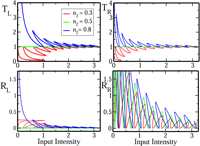
We show that parity-time (PT) symmetric Bragg periodic structures, near the spontaneous PT – symmetry breaking point, can act as unidirectional invisible media. In this regime, the re flection from one end is diminished while it is enhanced from the other. At the same time the transmission coefficient and phase, are indistinguishable from those expected in the absence of a grating. The phenomenon is robust even in the presence of Kerr non-linearities, and it can also eff?ectively suppress optical bistabilities.
http://arxiv.org/abs/1108.2493
Optics (physics.optics)