Dorje C. Brody
The Hermiticity condition in quantum mechanics required for the characterisation of (a) physical observables and (b) generators of unitary motions can be relaxed into a wider class of operators whose eigenvalues are real and whose eigenstates are complete. In this case, the orthogonality of eigenstates is replaced by the notion of biorthogonality that defines the relation between the Hilbert space of states and its dual space. The resulting quantum theory, which might appropriately be called ‘biorthogonal quantum mechanics’, is developed here in some detail in the case for which the Hilbert space dimensionality is finite. Specifically, characterisations of probability assignment rules, observable properties, pure and mixed states, spin particles, measurements, combined systems and entanglements, perturbations, and dynamical aspects of the theory are developed. The paper concludes with a brief discussion on infinite-dimensional systems.
http://arxiv.org/abs/1308.2609
Quantum Physics (quant-ph); Mathematical Physics (math-ph)
Dorje C. Brody, Eva-Maria Graefe
Information geometry provides a tool to systematically investigate parameter sensitivity of the state of a system. If a physical system is described by a linear combination of eigenstates of a complex (that is, non-Hermitian) Hamiltonian, then there can be phase transitions where dynamical properties of the system change abruptly. In the vicinities of the transition points, the state of the system becomes highly sensitive to the changes of the parameters in the Hamiltonian. The parameter sensitivity can then be measured in terms of the Fisher-Rao metric and the associated curvature of the parameter-space manifold. A general scheme for the geometric study of parameter-space manifolds of eigenstates of complex Hamiltonians is outlined here, leading to generic expressions for the metric.
http://arxiv.org/abs/1307.4017
Quantum Physics (quant-ph); Statistical Mechanics (cond-mat.stat-mech); Mathematical Physics (math-ph)
Dorje C. Brody
Wigner’s theorem asserts that an isometric (probability conserving) transformation on a quantum state space must be generated by a Hamiltonian that is Hermitian. It is shown that when the Hermiticity condition on the Hamiltonian is relaxed, we obtain the following complex generalisation of Wigner’s theorem: a holomorphically projective (complex geodesic-curves preserving) transformation on a quantum state space must be generated by a Hamiltonian that is not necessarily Hermitian.
http://arxiv.org/abs/1305.0658
Mathematical Physics (math-ph); High Energy Physics – Theory (hep-th); Differential Geometry (math.DG)
Dorje C. Brody, Eva-Maria Graefe
A model is proposed that describes the evolution of a mixed state of a quantum system for which gain and loss of energy or amplitude are present. Properties of the model are worked out in detail. In particular, invariant subspaces of the space of density matrices corresponding to the fixed points of the dynamics are identified, and the existence of a transition between the phase in which gain and loss are balanced and the phase in which this balance is lost is illustrated in terms of the time average of observables. The model is extended to include a noise term that results from a uniform random perturbation generated by white noise. Numerical studies of example systems show the emergence of equilibrium states that suppress the phase transition.
http://arxiv.org/abs/1208.5297
Quantum Physics (quant-ph); Mathematical Physics (math-ph)
Dorje C. Brody, Eva-Maria Graefe
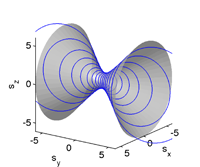 The dynamical aspects of a spin-1/2 particle in Hermitian coquaternionic quantum theory is investigated. It is shown that the time evolution exhibits three different characteristics, depending on the values of the parameters of the Hamiltonian. When energy eigenvalues are real, the evolution is either isomorphic to that of a complex Hermitian theory on a spherical state space, or else it remains unitary along an open orbit on a hyperbolic state space. When energy eigenvalues form a complex conjugate pair, the orbit of the time evolution closes again even though the state space is hyperbolic.
http://arxiv.org/abs/1105.4038
Mathematical Physics (math-ph); Quantum Physics (quant-ph)
Dorje C Brody, Eva-Maria Graefe
While real Hamiltonian mechanics and Hermitian quantum mechanics can both be cast in the framework of complex canonical equations, their complex generalisations have hitherto been remained tangential. In this paper quaternionic and coquaternionic (split-signature analogue of quaternions) extensions of Hamiltonian mechanics are introduced, and are shown to offer a unifying framework for complexified classical and quantum mechanics. In particular, quantum theories characterised by complex Hamiltonians invariant under space-time reflection are shown to be equivalent to certain coquaternionic extensions of Hermitian quantum theories. One of the interesting consequences is that the space-time dimension of these systems is six, not four, on account of the structures of coquaternionic quantum mechanics.
http://arxiv.org/abs/1012.0757
Mathematical Physics (math-ph); High Energy Physics – Theory (hep-th); Quantum Physics (quant-ph)
Carl M. Bender, Dorje C. Brody, Joao Caldeira, Bernard K. Meister
Suppose that a system is known to be in one of two quantum states, $|\psi_1 > $ or $|\psi_2 >$. If these states are not orthogonal, then in conventional quantum mechanics it is impossible with one measurement to determine with certainty which state the system is in. However, because a non-Hermitian PT-symmetric Hamiltonian determines the inner product that is appropriate for the Hilbert space of physical states, it is always possible to choose this inner product so that the two states $|\psi_1 > $ and $|\psi_2 > $ are orthogonal. Thus, quantum state discrimination can, in principle, be achieved with a single measurement.
http://arxiv.org/abs/1011.1871
High Energy Physics – Theory (hep-th); Mathematical Physics (math-ph); Quantum Physics (quant-ph)