Bijan Bagchi, Subhrajit Modak, Prasanta K. Panigrahi
The relevance of parity and time reversal (PT)-symmetric structures in optical systems is known for sometime with the correspondence existing between the Schrodinger equation and the paraxial equation of diffraction where the time parameter represents the propagating distance and the refractive index acts as the complex potential. In this paper, we systematically analyze a normalized form of the nonlinear Schrodinger system with two new families of PT-symmetric potentials in the presence of competing nonlinearities. We generate a class of localized eigenmodes and carry out a linear stability analysis on the solutions. In particular, we find an interesting feature of bifurcation charaterized by the parameter of perturbative growth rate passing through zero where a transition to imaginary eigenvalues occurs.
http://arxiv.org/abs/1307.7246
Quantum Physics (quant-ph); Mathematical Physics (math-ph); Exactly Solvable and Integrable Systems (nlin.SI)
Yogesh N. Joglekar, Bijan Bagchi
We investigate the effects of competition between two complex, \(\mathcal{PT}\)-symmetric potentials on the \(\mathcal{PT}\)-symmetric phase of a “particle in a box”. These potentials, given by \(V_Z(x)=iZ\mathrm{sign}(x)\) and \(V_\xi(x)=i\xi[\delta(x-a)-\delta(x+a)]\), represent long-range and localized gain/loss regions respectively. We obtain the \(\mathcal{PT}\)-symmetric phase in the \((Z,\xi)\) plane, and find that for locations \(\pm a\) near the edge of the box, the \(\mathcal{PT}\)-symmetric phase is strengthened by additional losses to the loss region. We also predict that a broken \(\mathcal{PT}\)-symmetry will be restored by increasing the strength \(\xi\) of the localized potential. By comparing the results for this problem and its lattice counterpart, we show that a robust \(\mathcal{PT}\)-symmetric phase in the continuum is consistent with the fragile phase on the lattice. Our results demonstrate that systems with multiple, \(\mathcal{PT}\)-symmetric potentials show unique, unexpected properties.
http://arxiv.org/abs/1206.3310
Quantum Physics (quant-ph)
Andrea Cavaglia, Andreas Fring, Bijan Bagchi
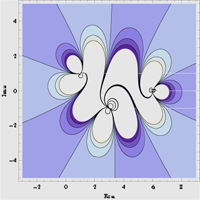 We investigate complex versions of the Korteweg-deVries equations and an Ito type nonlinear system with two coupled nonlinear fields. We systematically construct rational, trigonometric/hyperbolic, elliptic and soliton solutions for these models and focus in particular on physically feasible systems, that is those with real energies. The reality of the energy is usually attributed to different realisations of an antilinear symmetry, as for instance PT-symmetry. It is shown that the symmetry can be spontaneously broken in two alternative ways either by specific choices of the domain or by manipulating the parameters in the solutions of the model, thus leading to complex energies. Surprisingly the reality of the energies can be regained in some cases by a further breaking of the symmetry on the level of the Hamiltonian. In many examples some of the fixed points in the complex solution for the field undergo a Hopf bifurcation in the PT-symmetry breaking process. By employing several different variants of the symmetries we propose many classes of new invariant extensions of these models and study their properties. The reduction of some of these models yields complex quantum mechanical models previously studied.
http://arxiv.org/abs/1103.1832
Mathematical Physics (math-ph); High Energy Physics – Theory (hep-th); Quantum Physics (quant-ph)