Mohammed F. Saleh, Andrea Marini, Fabio Biancalana
We have investigated the interaction between a strong soliton and a weak probe with certain configurations that allow optical trapping in gas-filled hollow-core photonic crystal fibers in the presence of the shock effect. We have shown theoretically and numerically that the shock term can lead to an unbroken parity-time (PT) symmetry potential in these kinds of fibers. Reciprocity breaking, a remarkable feature of the PT symmetry, is also demonstrated numerically. Our results will open different configurations and avenues for observing PT-symmetry breaking in optical fibers, without the need to resort to cumbersome dissipative structures.
http://arxiv.org/abs/1310.7497
Optics (physics.optics)
Myrta Grüning, Andrea Marini, Xavier Gonze
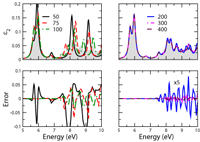 The treatment of the Random-Phase Approximation Hamiltonians, encountered in different frameworks, like Time-Dependent Density Functional Theory or Bethe-Salpeter equation, is complicated by their non-Hermicity. Compared to their Hermitian Hamiltonian counterparts, computational methods for the treatment of non-Hermitian Hamiltonians are often less efficient and less stable, sometimes leading to the breakdown of the method. Recently [Gruning et al. Nano Lett. 8, 2820 (2009)], we have identified that such Hamiltonians are usually pseudo-Hermitian. Exploiting this property, we have implemented an algorithm of the Lanczos type for random-Phase Approximation Hamiltonians that benefits from the same stability and computational load as its Hermitian counterpart, and applied it to the study of the optical response of carbon nanotubes. We present here the related theoretical grounds and technical details, and study the performance of the algorithm for the calculation of the optical absorption of a molecule within the Bethe-Salpeter equation framework.
http://arxiv.org/abs/1102.3909
Materials Science (cond-mat.mtrl-sci); Mathematical Physics (math-ph)