Carl M. Bender, Philip D. Mannheim
In nonrelativistic quantum mechanics and in relativistic quantum field theory, time t is a parameter and thus the time-reversal operator T does not actually reverse the sign of t. However, in relativistic quantum mechanics the time coordinate t and the space coordinates x are treated on an equal footing and all are operators. In this paper it is shown how to extend PT symmetry from nonrelativistic to relativistic quantum mechanics by implementing time reversal as an operation that changes the sign of the time coordinate operator t. Some illustrative relativistic quantum-mechanical models are constructed whose associated Hamiltonians are non-Hermitian but PT symmetric, and it is shown that for each such Hamiltonian the energy eigenvalues are all real.
http://arxiv.org/abs/1107.0501
High Energy Physics – Theory (hep-th); Mathematical Physics (math-ph); Quantum Physics (quant-ph)
Carl M. Bender, S. P. Klevansky
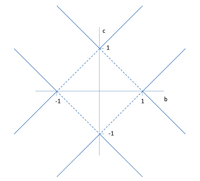 A recent paper by Jones-Smith and Mathur extends PT-symmetric quantum mechanics from bosonic systems (systems for which \(T^2=1\)) to fermionic systems (systems for which \(T^2=-1\)). The current paper shows how the formalism developed by Jones-Smith and Mathur can be used to construct PT-symmetric matrix representations for operator algebras of the form \(\eta^2=0\), \(\bar{\eta}^2=0\), \(\eta\bar{\eta}+\bar {\eta} =\alpha 1\), where \(\bar{eta}=\eta^{PT} =PT \eta T^{-1}P^{-1}\). It is easy to construct matrix representations for the Grassmann algebra (\(\alpha=0\)). However, one can only construct matrix representations for the fermionic operator algebra (\(\alpha \neq 0\)) if \(\alpha= -1\); a matrix representation does not exist for the conventional value \(\alpha=1\).
http://arxiv.org/abs/1104.4156
Subjects: High Energy Physics – Theory (hep-th); Mathematical Physics (math-ph); Quantum Physics (quant-ph)
Alexander G. Anderson, Carl M. Bender, Uriel I. Morone
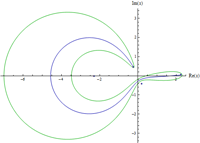 This paper revisits earlier work on complex classical mechanics in which it was argued that when the energy of a classical particle in an analytic potential is real, the particle trajectories are closed and periodic, but that when the energy is complex, the classical trajectories are open. Here it is shown that there is a discrete set of eigencurves in the complex-energy plane for which the particle trajectories are closed and periodic.
http://arxiv.org/abs/1102.4822
Mathematical Physics (math-ph); High Energy Physics – Theory (hep-th)
Carl M. Bender, Dorje C. Brody, Joao Caldeira, Bernard K. Meister
Suppose that a system is known to be in one of two quantum states, $|\psi_1 > $ or $|\psi_2 >$. If these states are not orthogonal, then in conventional quantum mechanics it is impossible with one measurement to determine with certainty which state the system is in. However, because a non-Hermitian PT-symmetric Hamiltonian determines the inner product that is appropriate for the Hilbert space of physical states, it is always possible to choose this inner product so that the two states $|\psi_1 > $ and $|\psi_2 > $ are orthogonal. Thus, quantum state discrimination can, in principle, be achieved with a single measurement.
http://arxiv.org/abs/1011.1871
High Energy Physics – Theory (hep-th); Mathematical Physics (math-ph); Quantum Physics (quant-ph)
Carl M. Bender, Daniel W. Hook
Classical mechanics is a singular theory in that real-energy classical particles can never enter classically forbidden regions. However, if one regulates classical mechanics by allowing the energy E of a particle to be complex, the particle exhibits quantum-like behavior: Complex-energy classical particles can travel between classically allowed regions separated by potential barriers. When Im(E) -> 0, the classical tunneling probabilities persist. Hence, one can interpret quantum tunneling as an anomaly. A numerical comparison of complex classical tunneling probabilities with quantum tunneling probabilities leads to the conjecture that as ReE increases, complex classical tunneling probabilities approach the corresponding quantum probabilities. Thus, this work attempts to generalize the Bohr correspondence principle from classically allowed to classically forbidden regions.
http://arxiv.org/abs/1011.0121
High Energy Physics – Theory (hep-th); Mathematical Physics (math-ph); Quantum Physics (quant-ph)
Carl M. Bender, R. J. Kalveks
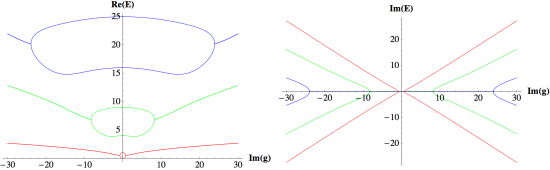
The E2 algebra has three elements, J, u, and v, which satisfy the commutation relations [u,J]=iv, [v,J]=-iu, [u,v]=0. We can construct the Hamiltonian H=J^2+gu, where g is a real parameter, from these elements. This Hamiltonian is Hermitian and consequently it has real eigenvalues. However, we can also construct the PT-symmetric and non-Hermitian Hamiltonian H=J^2+igu, where again g is real. As in the case of PT-symmetric Hamiltonians constructed from the elements x and p of the Heisenberg algebra, there are two regions in parameter space for this PT-symmetric Hamiltonian, a region of unbroken PT symmetry in which all the eigenvalues are real and a region of broken PT symmetry in which some of the eigenvalues are complex. The two regions are separated by a critical value of g.
http://arxiv.org/abs/1009.3236
High Energy Physics – Theory (hep-th); Mathematical Physics (math-ph); Quantum Physics (quant-ph)