Joshua Feinberg
We briefly discuss construction of energy-dependent effective non-hermitian hamiltonians for studying resonances in open disordered systems
http://arxiv.org/abs/1011.5932
Disordered Systems and Neural Networks (cond-mat.dis-nn); High Energy Physics – Theory (hep-th); Mathematical Physics (math-ph); Quantum Physics (quant-ph)
Miloslav Znojil
In an innovative inverse-problem construction the measured, experimental energies $E_1$, $E_2$, …$E_N$ of a quantum bound-state system are assumed fitted by an N-plet of zeros of a classical orthogonal polynomial $f_N(E)$. We reconstruct the underlying Hamiltonian $H$ (in the most elementary nearest-neighbor-interaction form) and the underlying Hilbert space ${\cal H}$ of states (the rich menu of non-equivalent inner products is offered). The Gegenbauer’s ultraspherical polynomials $f_n(x)=C_n^\alpha(x)$ are chosen for the detailed illustration of technicalities.
http://arxiv.org/abs/1011.4803
Quantum Physics (quant-ph); Mathematical Physics (math-ph)
Phys. Rev. A 82 (2010) 052113
DOI:10.1103/PhysRevA.82.052113
Miloslav Znojil, Miloš Tater
A new version of an elementary PT-symmetric square well quantum model is proposed in which a certain Hermiticity-violating end-point interaction leaves the spectrum real in a large domain of couplings $\lambda\in (-1,1)$. Within this interval we employ the usual coupling-independent operator P of parity and construct, in a systematic Runge-Kutta discrete approximation, a coupling-dependent operator of charge C which enables us to classify our P-asymmetric model as CPT-symmetric or, equivalently, hiddenly Hermitian alias cryptohermitian.
http://arxiv.org/abs/1011.4806
Quantum Physics (quant-ph); High Energy Physics – Theory (hep-th)
H. Hernandez-Coronado, D. Krejcirik, P. Siegl
![Transmissions |T|^2 as a function of energy k2 for the step-like potential <i>v</i> with a = Pi/4, epsilon_1 = 0.2, epsilon_3 = 0.5, beta_3 = -100, beta_2 = 0, beta_1 = -120 (continuous red line), and beta_1 = -200 (dashed blue line). See [5] for animated plots of |T|^2 as a function of potential.](http://ptsymmetry.net/wp-content/uploads/2010/11/figure4.png "figure4") We establish that a perfect-transmission scattering problem can be described by a class of parity and time reversal symmetric operators and hereby we provide a scenario for understanding and implementing the corresponding quasi-Hermitian quantum mechanical framework from the physical viewpoint. One of the most interesting features of the analysis is that the complex eigenvalues of the underlying non-Hermitian problem, associated with a reflectionless scattering system, lead to the loss of perfect-transmission energies as the parameters characterizing the scattering potential are varied. On the other hand, the scattering data can serve to describe the spectrum of a large class of Schroedinger operators with complex Robin boundary conditions.
We establish that a perfect-transmission scattering problem can be described by a class of parity and time reversal symmetric operators and hereby we provide a scenario for understanding and implementing the corresponding quasi-Hermitian quantum mechanical framework from the physical viewpoint. One of the most interesting features of the analysis is that the complex eigenvalues of the underlying non-Hermitian problem, associated with a reflectionless scattering system, lead to the loss of perfect-transmission energies as the parameters characterizing the scattering potential are varied. On the other hand, the scattering data can serve to describe the spectrum of a large class of Schroedinger operators with complex Robin boundary conditions.
http://arxiv.org/abs/1011.4281
Mathematical Physics (math-ph); Quantum Physics (quant-ph)
Carl M. Bender, Dorje C. Brody, Joao Caldeira, Bernard K. Meister
Suppose that a system is known to be in one of two quantum states, $|\psi_1 > $ or $|\psi_2 >$. If these states are not orthogonal, then in conventional quantum mechanics it is impossible with one measurement to determine with certainty which state the system is in. However, because a non-Hermitian PT-symmetric Hamiltonian determines the inner product that is appropriate for the Hilbert space of physical states, it is always possible to choose this inner product so that the two states $|\psi_1 > $ and $|\psi_2 > $ are orthogonal. Thus, quantum state discrimination can, in principle, be achieved with a single measurement.
http://arxiv.org/abs/1011.1871
High Energy Physics – Theory (hep-th); Mathematical Physics (math-ph); Quantum Physics (quant-ph)
Henning Schomerus
![(a) Sketch of a nonhermitian PT-symmetric system, where a region with absorption rate μ (and mean level spacing, left) is coupled symmetrically via a tunnel barrier (supporting N channels with transmission probability T) to an amplifying region with a matching amplification rate (right). Below this, the scattering description of the system. (b) Two routes to spontaneous PT-symmetry breaking, depending on whether the hermitian limit μ = 0 is T -symmetric (orthogonal class displaying level crossings, left) or not (unitary class displaying avoided crossings, right). Shown are real eigenvalues of a random Hamiltonian H [Eq. (4)] as function of T for fixed μ = 0 (left of dashed line), and then as a function of μ for fixed T = 1 (right of dashed line). Complex-valued levels (formed by level coalescence at μ > 0) are not shown. Here μ0 = √N�/2�, and we set N = 10.](http://ptsymmetry.net/wp-content/uploads/2010/11/fig1.png "fig1") PT-symmetric systems can have a real spectrum even when their Hamiltonian is non-hermitian, but develop a complex spectrum when the degree of non-hermiticity increases. Here we utilize random-matrix theory to show that this spontaneous PT-symmetry breaking can occur via two distinct mechanisms, whose predominance is associated to different universality classes. Present optical experiments fall into the orthogonal class, where symmetry-induced level crossings render the characteristic absorption rate independent of the coupling strength between the symmetry-related parts of the system.
PT-symmetric systems can have a real spectrum even when their Hamiltonian is non-hermitian, but develop a complex spectrum when the degree of non-hermiticity increases. Here we utilize random-matrix theory to show that this spontaneous PT-symmetry breaking can occur via two distinct mechanisms, whose predominance is associated to different universality classes. Present optical experiments fall into the orthogonal class, where symmetry-induced level crossings render the characteristic absorption rate independent of the coupling strength between the symmetry-related parts of the system.
http://arxiv.org/abs/1011.1385
Subjects: Quantum Physics (quant-ph); Mesoscale and Nanoscale Physics (cond-mat.mes-hall); Optics (physics.optics)
Kumar Abhinav, Prasanta K. Panigrahi
Dynamical systems exhibiting both PT and Supersymmetry are analyzed in a general scenario. It is found that, in an appropriate parameter domain, the ground state may or may not respect PT-symmetry. Interestingly, in the domain where PT-symmetry is not respected, two superpotentials give rise to one potential; whereas when the ground state respects PT, this correspondence is unique. In both scenarios, supersymmetry and shape-invariance are intact, through which one can obtain eigenfunctions and eigenstates exactly. Our procedure enables one to generate a host of complex potentials which are not PT-symmetric, and can be exactly solved.
http://arxiv.org/abs/1011.0084
Quantum Physics (quant-ph)
Carl M. Bender, Daniel W. Hook
Classical mechanics is a singular theory in that real-energy classical particles can never enter classically forbidden regions. However, if one regulates classical mechanics by allowing the energy E of a particle to be complex, the particle exhibits quantum-like behavior: Complex-energy classical particles can travel between classically allowed regions separated by potential barriers. When Im(E) -> 0, the classical tunneling probabilities persist. Hence, one can interpret quantum tunneling as an anomaly. A numerical comparison of complex classical tunneling probabilities with quantum tunneling probabilities leads to the conjecture that as ReE increases, complex classical tunneling probabilities approach the corresponding quantum probabilities. Thus, this work attempts to generalize the Bohr correspondence principle from classically allowed to classically forbidden regions.
http://arxiv.org/abs/1011.0121
High Energy Physics – Theory (hep-th); Mathematical Physics (math-ph); Quantum Physics (quant-ph)
Gerard ‘t Hooft
In canonical quantum gravity, the formal functional integral includes an integration over the local conformal factor, and we propose to perform the functional integral over this factor before doing any of the other functional integrals. By construction, the resulting effective theory would be expected to be conformally invariant and therefore finite. However, also the conformal integral itself diverges, and the effects of a renormalization counter term are considered. It generates problems such as unitarity violation, due to a Landau-like ghost, and conformal anomalies. Adding (massive or massless) matter fields does not change the picture. Various alternative ideas are offered, including a more daring speculation, which is that no counter term should be allowed for at all. This has far-reaching and important consequences, which we discuss. A surprising picture emerges of quantized elementary particles interacting with a gravitational field, in particular gravitons, which are “partly classical”. This approach was inspired by a search towards the reconciliation of Hawking radiation with unitarity and locality, and it offers basic new insights there.
Comments: 22 pages (incl. title page), 1 figure. Substantial changes in the discussion sections, minor errors corrected, and references added
http://arxiv.org/abs/1009.0669
General Relativity and Quantum Cosmology (gr-qc); High Energy Physics – Theory (hep-th)
Eva-Maria Graefe, Roman Schubert
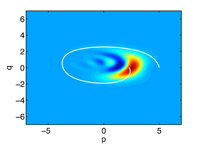 The quantum evolution of the Wigner function for Gaussian wave packets generated by a non-Hermitian Hamiltonian is investigated. In the semiclassical limit $\hbar\to 0$ this yields the non-Hermitian analog of the Ehrenfest theorem for the dynamics of observable expectation values. The lack of Hermiticity reveals the importance of the complex structure on the classical phase space: The resulting equations of motion are coupled to an equation of motion for the phase space metric—a phenomenon having no analogue in Hermitian theories. Furthermore, example studies show that the anti-Hermitian term can improve the accuracy of the classical approximation.
http://arxiv.org/abs/1010.4557
Quantum Physics (quant-ph); Mathematical Physics (math-ph)