Miloslav Znojil
An array of N subsequent Laguerre polynomials is interpreted as an eigenvector of a non-Hermitian tridiagonal Hamiltonian $H$ with real spectrum or, better said, of an exactly solvable N-site-lattice cryptohermitian Hamiltonian whose spectrum is known as equal to the set of zeros of the N-th Laguerre polynomial. The two key problems (viz., the one of the ambiguity and the one of the closed-form construction of all of the eligible inner products which make $H$ Hermitian in the respective {\em ad hoc} Hilbert spaces) are discussed. Then, for illustration, the first four simplest, $k-$parametric definitions of inner products with $k=0,k=1,k=2$ and $k=3$ are explicitly displayed. In mathematical terms these alternative inner products may be perceived as alternative Hermitian conjugations of the initial N-plet of Laguerre polynomials. In physical terms the parameter $k$ may be interpreted as a measure of the “smearing of the lattice coordinates” in the model.
http://arxiv.org/abs/1101.1183
Mathematical Physics (math-ph); Quantum Physics (quant-ph)
A. Sinha, D. Dutta, P. Roy
We apply the factorization technique developed by Kuru and Negro [Ann. Phys. 323 (2008) 413] to study complex classical systems. As an illustration we apply the technique to study the classical analogue of the exactly solvable PT symmetric Scarf II model, which exhibits the interesting phenomenon of spontaneous breakdown of PT symmetry at some critical point. As the parameters are tuned such that energy switches from real to complex conjugate pairs, the corresponding classical trajectories display a distinct characteristic feature – the closed orbits become open ones.
http://arxiv.org/abs/1101.0909
Quantum Physics (quant-ph)
Physics Letters A : vol. 375 (2011) p 452-457
Miloslav Znojil
Non-hermitian quantum graphs possessing real (i.e., in principle, observable) spectra are studied via their discretization. The discretized Hamiltonians are assigned, constructively, an elementary pseudometric and/or a more complicated metric. Both these constructions make the Hamiltonian Hermitian, respectively, in an auxiliary (Krein or Pontryagin) vector space or in a less friendly (but more useful) Hilbert space of quantum mechanics.
http://arxiv.org/abs/1101.1015
Quantum Physics (quant-ph); Mathematical Physics (math-ph)
L. Jin, Z. Song
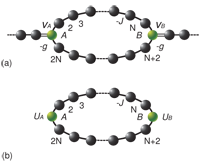 We explore a way of finding the link between a non-Hermitian Hamiltonian and a Hermitian one. Based on the analysis of Bethe Ansatz solutions for a class of non-Hermitian Hamiltonians and the scattering problems for the corresponding Hermitian Hamiltonians. It is shown that a scattering state of an arbitrary Hermitian lattice embedded in a chain as the scattering center shares the same wave function with the corresponding non-Hermitian tight binding lattice, which consists of the Hermitian lattice with two additional on-site complex potentials, no matter the non-Hermitian is broken PT symmetry or even non-PT. An exactly solvable model is presented to demonstrate the main points of this article.
http://arxiv.org/abs/1101.0351
Quantum Physics (quant-ph)
Yogesh N. Joglekar, William A. Karr
We investigate the eigenvalue distribution $\sigma(x)$ and level-spacing distribution $p(s)$ of random matrices $M=AF\neq M^{\dagger}$ where $F$ is a diagonal inner-product and $A$ is a random, real symmetric or complex Hermitian matrix with independent entries drawn from a probability distribution $q(x)$ with zero mean and finite higher moments. Although not Hermitian, the matrix $M$ is self-adjoint with respect to $F$ and thus has a purely real spectrum. We find that the eigenvalue probability distribution $\sigma_F(x)$ is independent of the underlying distribution $q(x)$, is solely characterized by $F$, and therefore generalizes Wigner’s semicircle distribution $\sigma_W(x)$. We find that the level-spacing distributions $p(s)$ are independent of $q(x)$, are dependent upon the inner-product $F$ and whether $A$ is real or complex, and therefore generalize Wigner’s surmise for level spacing.
http://arxiv.org/abs/1012.1202
Disordered Systems and Neural Networks (cond-mat.dis-nn); Statistical Mechanics (cond-mat.stat-mech)
Andreas Fring, Monique Smith
We provide a construction procedure for complex root spaces invariant under antilinear transformations, which may be applied to any Coxeter group. The procedure is based on the factorisation of a chosen element of the Coxeter group into two factors. Each of the factors constitutes an involution and may therefore be deformed in an antilinear fashion. Having the importance of the E(8)-Coxeter group in mind, such as underlying a particular perturbation of the Ising model and the fact that for it no solution could be found previously, we exemplify the procedure for this particular case. As a concrete application of this construction we propose new generalisations of Calogero-Moser Sutherland models and affine Toda field theories based on the invariant complex root spaces and deformed complex simple roots, respectively.
http://arxiv.org/abs/1010.2218
Mathematical Physics (math-ph); High Energy Physics – Theory (hep-th); Quantum Physics (quant-ph)
Pijush K. Ghosh
A class of non-Dirac-hermitian many-particle quantum systems admitting entirely real spectra and unitary time-evolution is presented. These quantum models are isospectral with Dirac-hermitian systems and are exactly solvable. The general method involves a realization of the basic canonical commutation relations defining the quantum system in terms of operators those are hermitian with respect to a pre-determined positive definite metric in the Hilbert space. Appropriate combinations of these operators result in a large number of pseudo-hermitian quantum systems admitting entirely real spectra and unitary time evolution. Examples of a pseudo-hermitian rational Calogero model and XXZ spin-chain are considered.
http://arxiv.org/abs/1012.0907
Quantum Physics (quant-ph); Strongly Correlated Electrons (cond-mat.str-el); High Energy Physics – Theory (hep-th); Mathematical Physics (math-ph)
Alessandro Sergi
Non-Hermitian quantum dynamics can be defined by giving a more fundamental role either to the Heisenberg’s or to the Schr\”odinger’s picture of quantum dynamics. In both cases, it is shown how to map the algebra of commutators, defining time evolution in terms of a non-Hermitian Hamiltonian, onto a non-Hamiltonian algebra with a Hermitian Hamiltonian. The results and discussions are of interest to methods for simulating open quantum systems dynamics in terms of non-Hermitian time evolution.
http://arxiv.org/abs/1012.0906
Quantum Physics (quant-ph)
Dorje C Brody, Eva-Maria Graefe
While real Hamiltonian mechanics and Hermitian quantum mechanics can both be cast in the framework of complex canonical equations, their complex generalisations have hitherto been remained tangential. In this paper quaternionic and coquaternionic (split-signature analogue of quaternions) extensions of Hamiltonian mechanics are introduced, and are shown to offer a unifying framework for complexified classical and quantum mechanics. In particular, quantum theories characterised by complex Hamiltonians invariant under space-time reflection are shown to be equivalent to certain coquaternionic extensions of Hermitian quantum theories. One of the interesting consequences is that the space-time dimension of these systems is six, not four, on account of the structures of coquaternionic quantum mechanics.
http://arxiv.org/abs/1012.0757
Mathematical Physics (math-ph); High Energy Physics – Theory (hep-th); Quantum Physics (quant-ph)
Paulo E. G. Assis
A class of non-Hermitian quadratic su(2) Hamiltonians that fulfil an anti-linear symmetry is constructed. If unbroken this anti-linear symmetry leads to a purely real spectrum and the Hamiltonian can be mapped to a Hermitian counterpart by, amongst other possibilities, a similarity transformation. Here Lie-algebraic methods which were used to investigate the generalised Swanson Hamiltonian is used to construct a class of quadratic Hamiltonians that allow for such a simple mapping to the Hermitian counterpart. While for the linear su(2) Hamiltonian every Hamiltonian of this type can be mapped to a Hermitian counterpart by a transformation which is itself an exponential of a linear combination of su(2) generators, the situation is more complicated for quadratic Hamiltonians. The existence of finite dimensional representations for the su(2) Hamiltonian, as opposed to the su(1,1) studied before, allows for comparison with explicit diagonalisation results for finite matrices. The possibility of more elaborate similarity transformations, including quadratic exponents, is also discussed. Finally, the similarity transformations are compared with the analogue of Swanson’s method of diagonalising the problem.
http://arxiv.org/abs/1012.0194
Quantum Physics (quant-ph); Mathematical Physics (math-ph)