M. Brandstetter, M. Liertzer, C. Deutsch, P. Klang, J. Schöberl, H. E. Türeci, G. Strasser, K. Unterrainer, S. Rotter
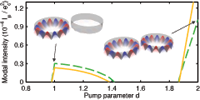
When two resonant modes in a system with gain or loss coalesce in both their resonance position and their width, a so-called “Exceptional Point” occurs which acts as a source of non-trivial physics in a diverse range of systems. Lasers provide a natural setting to study such “non-Hermitian degeneracies”, since they feature resonant modes and a gain material as their basic constituents. Here we show that Exceptional Points can be conveniently induced in a photonic molecule laser by a suitable variation of the applied pump. Using a pair of coupled micro-disk quantum cascade lasers, we demonstrate that in the vicinity of these Exceptional Points the laser shows a characteristic reversal of its pump-dependence, including a strongly decreasing intensity of the emitted laser light for increasing pump power. This result establishes photonic molecule lasers as promising tools for exploring many further fascinating aspects of Exceptional Points, like a strong line-width enhancement and the coherent perfect absorption of light in their vicinity as well as non-trivial mode-switching and the accumulation of a geometric phase when encircling an Exceptional Point parametrically.
http://arxiv.org/abs/1404.1837
Optics (physics.optics); Mesoscale and Nanoscale Physics (cond-mat.mes-hall); Chaotic Dynamics (nlin.CD)
Philipp Ambichl, Konstantinos G. Makris, Li Ge, Yidong Chong, A. Douglas Stone, Stefan Rotter
PT-symmetric scattering systems with balanced gain and loss can undergo a symmetry-breaking transition in which the eigenvalues of the non-unitary scattering matrix change their phase shifts from real to complex values. We relate the PT-symmetry breaking points of such an unbounded scattering system to those of underlying bounded systems. In particular, we show how the PT-thresholds in the scattering matrix of the unbounded system translate into analogous transitions in the Robin boundary conditions of the corresponding bounded systems. Based on this relation, we argue and then confirm that the PT-transitions in the scattering matrix are, under very general conditions, entirely insensitive to a variable coupling strength between the bounded region and the unbounded asymptotic region, a result which can be tested experimentally.
http://arxiv.org/abs/1307.0149
Optics (physics.optics); Quantum Physics (quant-ph)
Li Ge, H. E. Tureci
In this Letter we study a new class of synthetic materials in which the refractive index satisfies a special symmetry, \(n(-x)=-n^*(x)\), which we term antisymmetric parity-time (APT) systems. Unlike PT-symmetric systems which require balanced gain and loss, i.e. \(n(-x)=n^*(x)\), APT systems consist of balanced positive and negative index materials (NIMs). Despite the seemingly PT-symmetric optical potential \(V(x)\equiv n(x)^2\omega^2/c^2\), such systems are not invariant under combined PT operation due to the discontinuity of the spatial derivative of the wavefunction. We show that APT systems display intriguing properties such as spontaneous phase transition of the scattering matrix, bidirectional invisibility, and a continuous lasing spectrum.
http://arxiv.org/abs/1208.4644
Optics (physics.optics)
Li Ge, Y. D. Chong, A. D. Stone
We analyze the optical properties of one-dimensional (1D) PT-symmetric structures of arbitrary complexity. These structures violate normal unitarity (photon flux conservation) but are shown to satisfy generalized unitarity relations, which relate the elements of the scattering matrix and lead to a conservation relation in terms of the transmittance and (left and right) reflectances. One implication of this relation is that there exist anisotropic transmission resonances in PT-symmetric systems, frequencies at which there is unit transmission and zero reflection, but only for waves incident from a single side. The spatial profile of these transmission resonances is symmetric, and they can occur even at PT-symmetry breaking points. The general conservation relations can be utilized as an experimental signature of the presence of PT-symmetry and of PT-symmetry breaking transitions. The uniqueness of PT-symmetry breaking transitions of the scattering matrix is briefly discussed by comparing to the corresponding non-Hermitian Hamiltonians.
http://arxiv.org/abs/1112.5167
Optics (physics.optics)
 M. Liertzer, Li Ge, A. Cerjan, A. D. Stone, H. E. Türeci, S. Rotter
We demonstrate that the above-threshold behavior of a laser can be strongly affected by exceptional points which are induced by pumping the laser non-uniformly. At these singularities the eigenstates of the non-Hermitian operator which describes the lasing modes coalesce. In the vicinity of these points the laser may turn off even when the overall pump power deposited in the system is increased. We suggest that such signatures of a pump-induced exceptional point can be experimentally probed with coupled ridge or microdisk lasers.
http://arxiv.org/abs/1109.0454
Optics (physics.optics)
http://arxiv.org/abs/1109.0454