B. Peng, S. K. Ozdemir, S. Rotter, H. Yilmaz, M. Liertzer, F. Monifi, C. M. Bender, F. Nori, L. Yang
Controlling and reversing the effects of loss are major challenges in optical systems. For lasers losses need to be overcome by a sufficient amount of gain to reach the lasing threshold. We show how to turn losses into gain by steering the parameters of a system to the vicinity of an exceptional point (EP), which occurs when the eigenvalues and the corresponding eigenstates of a system coalesce. In our system of coupled microresonators, EPs are manifested as the loss-induced suppression and revival of lasing. Below a critical value, adding loss annihilates an existing Raman laser. Beyond this critical threshold, lasing recovers despite the increasing loss, in stark contrast to what would be expected from conventional laser theory. Our results exemplify the counterintuitive features of EPs and present an innovative method for reversing the effect of loss.
http://arxiv.org/abs/1410.7474
Optics (physics.optics); Quantum Physics (quant-ph)
M. Brandstetter, M. Liertzer, C. Deutsch, P. Klang, J. Schöberl, H. E. Türeci, G. Strasser, K. Unterrainer, S. Rotter
When two resonant modes in a system with gain or loss coalesce in both their resonance position and their width, a so-called “Exceptional Point” occurs which acts as a source of non-trivial physics in a diverse range of systems. Lasers provide a natural setting to study such “non-Hermitian degeneracies”, since they feature resonant modes and a gain material as their basic constituents. Here we show that Exceptional Points can be conveniently induced in a photonic molecule laser by a suitable variation of the applied pump. Using a pair of coupled micro-disk quantum cascade lasers, we demonstrate that in the vicinity of these Exceptional Points the laser shows a characteristic reversal of its pump-dependence, including a strongly decreasing intensity of the emitted laser light for increasing pump power. This result establishes photonic molecule lasers as promising tools for exploring many further fascinating aspects of Exceptional Points, like a strong line-width enhancement and the coherent perfect absorption of light in their vicinity as well as non-trivial mode-switching and the accumulation of a geometric phase when encircling an Exceptional Point parametrically.
http://arxiv.org/abs/1404.1837
Optics (physics.optics); Mesoscale and Nanoscale Physics (cond-mat.mes-hall); Chaotic Dynamics (nlin.CD)
Stefano Longhi
We investigate the onset of parity-time (PT) symmetry breaking in non-Hermitian tight-binding lattices with spatially-extended loss/gain regions in presence of an advective term. Similarly to the instability properties of hydrodynamic open flows, it is shown that PT-symmetry breaking can be either absolute or convective. In the former case, an initially-localized wave packet shows a secular growth with time at any given spatial position, whereas in the latter case the growth is observed in a reference frame moving at some drift velocity while decay occurs at any fixed spatial position. In the convective unstable regime, PT-symmetry is restored when the spatial region of gain/loss in the lattice is limited (rather than extended). We consider specifically a non-Hermitian extension of the Rice-Mele tight binding lattice model, and show the existence of a transition from absolute to convective symmetry breaking when the advective term is large enough. An extension of the analysis to ac-dc-driven lattices is also presented, and an optical implementation of the non-Hermitian Rice-Mele model is suggested, which is based on light transport in an array of evanescently-coupled optical waveguides with a periodically-bent axis and alternating regions of optical gain and loss.
http://arxiv.org/abs/1310.5004
Quantum Physics (quant-ph); Mesoscale and Nanoscale Physics (cond-mat.mes-hall)
Philipp Ambichl, Konstantinos G. Makris, Li Ge, Yidong Chong, A. Douglas Stone, Stefan Rotter
PT-symmetric scattering systems with balanced gain and loss can undergo a symmetry-breaking transition in which the eigenvalues of the non-unitary scattering matrix change their phase shifts from real to complex values. We relate the PT-symmetry breaking points of such an unbounded scattering system to those of underlying bounded systems. In particular, we show how the PT-thresholds in the scattering matrix of the unbounded system translate into analogous transitions in the Robin boundary conditions of the corresponding bounded systems. Based on this relation, we argue and then confirm that the PT-transitions in the scattering matrix are, under very general conditions, entirely insensitive to a variable coupling strength between the bounded region and the unbounded asymptotic region, a result which can be tested experimentally.
http://arxiv.org/abs/1307.0149
Optics (physics.optics); Quantum Physics (quant-ph)
 M. Liertzer, Li Ge, A. Cerjan, A. D. Stone, H. E. Türeci, S. Rotter
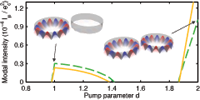
We demonstrate that the above-threshold behavior of a laser can be strongly affected by exceptional points which are induced by pumping the laser non-uniformly. At these singularities the eigenstates of the non-Hermitian operator which describes the lasing modes coalesce. In the vicinity of these points the laser may turn off even when the overall pump power deposited in the system is increased. We suggest that such signatures of a pump-induced exceptional point can be experimentally probed with coupled ridge or microdisk lasers.
http://arxiv.org/abs/1109.0454
Optics (physics.optics)
http://arxiv.org/abs/1109.0454