Eva-Maria Graefe, Hans Jürgen Korsch, Alexander Rush, Roman Schubert
The non-Hermitian quadratic oscillator studied by Swanson is one of the popular PT-symmetric model systems. Here a full classical description of its dynamics is derived using recently developed metriplectic flow equations, which combine the classical symplectic flow for Hermitian systems with a dissipative metric flow for the anti-Hermitian part. Closed form expressions for the metric and phase-space trajectories are presented which are found to be periodic in time. Since the Hamiltonian is only quadratic the classical dynamics exactly describes the quantum dynamics of Gaussian wave packets. It is shown that the classical metric and trajectories as well as the quantum wave functions can diverge in finite time even though the PT-symmetry is unbroken, i.e., the eigenvalues are purely real.
http://arxiv.org/abs/1409.6456
Quantum Physics (quant-ph); Mathematical Physics (math-ph)
Eva-Maria Graefe, Roman Schubert
The complex geometry underlying the Schr\”odinger dynamics of coherent states for non-Hermitian Hamiltonians is investigated. In particular two seemingly contradictory approaches are compared: (i) a complex WKB formalism, for which the centres of coherent states naturally evolve along complex trajectories, which leads to a class of complexified coherent states; (ii) the investigation of the dynamical equations for the real expectation values of position and momentum, for which an Ehrenfest theorem has been derived in a previous paper, yielding real but non-Hamiltonian classical dynamics on phase space for the real centres of coherent states. Both approaches become exact for quadratic Hamiltonians. The apparent contradiction is resolved building on an observation by Huber, Heller and Littlejohn, that complexified coherent states are equivalent if their centres lie on a specific complex Lagrangian manifold. A rich underlying complex symplectic geometry is unravelled. In particular a natural complex structure is identified that defines a projection from complex to real phase space, mapping complexified coherent states to their real equivalents.
http://arxiv.org/abs/1111.1877
Mathematical Physics (math-ph); Quantum Physics (quant-ph)
Eva-Maria Graefe, Roman Schubert
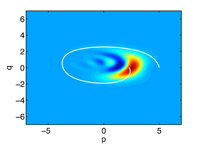 The quantum evolution of the Wigner function for Gaussian wave packets generated by a non-Hermitian Hamiltonian is investigated. In the semiclassical limit $\hbar\to 0$ this yields the non-Hermitian analog of the Ehrenfest theorem for the dynamics of observable expectation values. The lack of Hermiticity reveals the importance of the complex structure on the classical phase space: The resulting equations of motion are coupled to an equation of motion for the phase space metric—a phenomenon having no analogue in Hermitian theories. Furthermore, example studies show that the anti-Hermitian term can improve the accuracy of the classical approximation.
http://arxiv.org/abs/1010.4557
Quantum Physics (quant-ph); Mathematical Physics (math-ph)