Baogang Zhu, Rong Lu, Shu Chen
We study the parity- and time-reversal PT symmetric non-Hermitian Su-Schrieffer-Heeger (SSH) model with two conjugated imaginary potentials \(\pm i\gamma\) at two end sites. The SSH model is known as one of the simplest two-band topological models which has topologically trivial and nontrivial phases. We find that the non-Hermitian terms can lead to different effects on the properties of the eigenvalues spectrum in topologically trivial and nontrivial phases. In the topologically trivial phase, the system undergos an abrupt transition from unbroken PT-symmetry region to spontaneously broken \(\mathcal{PT}\)-symmetry region at a certain \(\gamma_{c}\), and a second transition occurs at another transition point \(\gamma_{c^{‘}}\) when further increasing the strength of the imaginary potential \(\gamma\). But in the topologically nontrivial phase, the zero-mode edge states become unstable for arbitrary nonzero \(\gamma\) and the \(\mathcal{PT}\)-symmetry of the system is spontaneously broken, which is characterized by the emergence of a pair of conjugated imaginary modes.
http://arxiv.org/abs/1405.5591
Other Condensed Matter (cond-mat.other); Quantum Physics (quant-ph)
Jun-Qing Li, Yan-Gang Miao
By adding an imaginary potential proportional to \(ip_1p_2\) to the hamiltonian of an anisotropic planar oscillator, we construct a model which is described by a non-hermitian hamiltonian with PT pseudo-hermiticity. We introduce the mechanism of the spontaneous breaking of permutation symmetry of the hamiltonian for diagonalizing the hamiltonian. By applying the definition of annihilation and creation operators which are PT pseudo-hermitian adjoint to each other, we give the real spectra.
http://arxiv.org/abs/1110.2312
Quantum Physics (quant-ph)
Jun-Qing Li, Yan-Gang Miao
By adding an imaginary potential proportional to ip_1p_2 to the hamiltonian of an anisotropic planar oscillator, we construct a model which is described by a non-hermitian hamiltonian with PT pseudo-hermiticity. We introduce the mechanism of the spontaneous breaking of permutation symmetry of the hamiltonian for diagonalizing the hamiltonian. By applying the definition of annihilation and creation operators which are PT pseudo-hermitian adjoint to each other, we give the real spectra.
http://arxiv.org/abs/1110.2312
Quantum Physics (quant-ph)
Harald Fritzsch, Zhi-zhong Xing, Ye-Ling Zhou
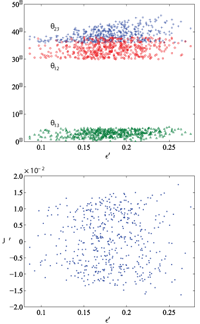 We show that non-Hermitian and nearest-neighbor-interacting perturbations to the Fritzsch textures of lepton and quark mass matrices can make both of them fit current experimental data very well. In particular, we obtain \theta_{23} \simeq 45^\circ for the atmospheric neutrino mixing angle and predict \theta_{13} \simeq 3^\circ to 6^\circ for the smallest neutrino mixing angle when the perturbations in the lepton sector are at the 20% level. The same level of perturbations is required in the quark sector, where the Jarlskog invariant of CP violation is about 3.7 \times 10^{-5}. In comparison, the strength of leptonic CP violation is possible to reach about 1.5 \times 10^{-2} in neutrino oscillations.
http://arxiv.org/abs/1101.4272
High Energy Physics – Phenomenology (hep-ph)
Zhenya Yan, Bo Xiong, Wu-Ming Liu
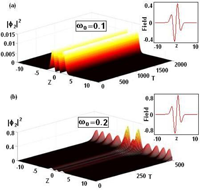 We report explicitly a novel family of exact PT-symmetric solitons and further study their spontaneous PT symmetry breaking, stabilities and collisions in Bose-Einstein condensates trapped in a PT-symmetric harmonic trap and a Hermite-Gaussian gain/loss potential. We observe the significant effects of mean-field interaction by modifying the threshold point of spontaneous PT symmetry breaking in Bose-Einstein condensates. Our scenario provides a promising approach to study PT-related universal behaviors in non-Hermitian quantum system based on the manipulation of gain/loss potential in Bose-Einstein condensates.
http://arxiv.org/abs/1009.4023
Quantum Gases (cond-mat.quant-gas)