R. Driben, B. A. Malomed
Dynamics of symmetric and antisymmetric 2-solitons and 3-solitons is studied in the model of the nonlinear dual-core coupler and its PT-symmetric version. Regions of the convergence of the injected perturbed symmetric and antisymmetric N-solitons into symmetric and asymmetric quasi-solitons are found. In the PT-symmetric system, with the balanced gain and loss acting in the two cores, borders of the stability against the blowup are identified. Notably, in all the cases the stability regions are larger for antisymmetric 2-soliton inputs than for their symmetric counterparts, on the contrary to previously known results for fundamental solitons (N=1). Dynamical regimes (switching) are also studied for the 2-soliton injected into a single core of the coupler. In particular, a region of splitting of the input into a pair of symmetric solitons is found, which is explained as a manifestation of the resonance between the vibrations of the 2-soliton and oscillations of energy between the two cores in the coupler.
http://arxiv.org/abs/1207.3917
Optics (physics.optics); Pattern Formation and Solitons (nlin.PS)
Kai Li, P. G. Kevrekidis, Boris A. Malomed, Uwe Guenther
We introduce four basic two-dimensional (2D) plaquette configurations with onsite cubic nonlinearities, which may be used as building blocks for 2D PT -symmetric lattices. For each configuration, we develop a dynamical model and examine its PT symmetry. The corresponding nonlinear modes are analyzed starting from the Hamiltonian limit, with zero value of the gain-loss coefficient. Once the relevant waveforms have been identified (chiefly, in an analytical form), their stability is examined by means of linearization in the vicinity of stationary points. This reveals diverse and, occasionally, fairly complex bifurcations. The evolution of unstable modes is explored by means of direct simulations. In particular, stable localized modes are found in these systems, although the majority of identified solutions is unstable.
http://arxiv.org/abs/1204.5530
Quantum Physics (quant-ph); High Energy Physics – Theory (hep-th)
R. Driben, B. A. Malomed
We introduce a system based on dual-core nonlinear waveguides with the balanced gain and loss acting separately in the cores. The system features a “supersymmetry” when the gain and loss are equal to the inter-core coupling. This system admits a variety of exact solutions (we focus on solitons), which are subject to a specific subexponential instability. We demonstrate that the application of a “management”, in the form of periodic simultaneous switch of the sign of the gain, loss, and inter-coupling, effectively stabilizes solitons, without destroying the supersymmetry. The management turns the solitons into attractors, for which an attraction basin is identified. The initial amplitude asymmetry and phase mismatch between the components transforms the solitons into quasi-stable breathers.
http://arxiv.org/abs/1110.2409
Optics (physics.optics); Pattern Formation and Solitons (nlin.PS)
Sergey V. Suchkov, Boris A. Malomed, Sergey V. Dmitriev, Yuri S. Kivshar
Dynamics of a chain of interacting parity-time invariant nonlinear dimers is investigated. A dimer is built as a pair of coupled elements with equal gain and loss. A relation between stationary soliton solutions of the model and solitons of the discrete nonlinear Schrodinger (DNLS) equation is demonstrated. Approximate solutions for solitons whose width is large in comparison to the lattice spacing are derived, using a continuum counterpart of the discrete equations. These solitons are mobile, featuring nearly elastic collisions. Stationary solutions for narrow solitons, which are immobile due to the pinning by the effective Peierls-Nabarro potential, are constructed numerically, starting from the anti-continuum limit. The solitons with the amplitude exceeding a certain critical value suffer an instability leading to blowup, which is a specific feature of the nonlinear PT-symmetric chain, making it dynamically different from DNLS lattices. A qualitative explanation of this feature is proposed. The instability threshold drops with the increase of the gain-loss coefficient, but it does not depend on the lattice coupling constant, nor on the soliton’s velocity.
http://arxiv.org/abs/1110.1501
Optics (physics.optics)
Rodislav Driben, Boris A. Malomed
Families of analytical solutions are found for symmetric and antisymmetric solitons in the dual-core system with the Kerr nonlinearity and PT-balanced gain and loss. The crucial issue is stability of the solitons. A stability region is obtained in an analytical form, and verified by simulations, for the PT-symmetric solitons. For the antisymmetric ones, the stability border is found in a numerical form. Moving solitons of both types collide elastically. The two soliton species merge into one in the “supersymmetric” case, with equal coefficients of the gain, loss and inter-core coupling. These solitons feature a subexponential instability, which may be suppressed by periodic switching (“management”).
http://arxiv.org/abs/1109.5759
Optics (physics.optics); Pattern Formation and Solitons (nlin.PS)
Andrey E. Miroshnichenko, Boris A. Malomed, Yuri S. Kivshar
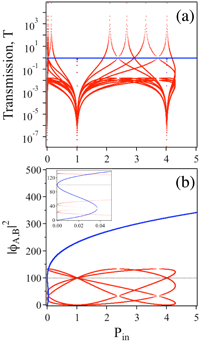 We introduce a class of PT-symmetric systems which include mutually matched nonlinear loss and gain (inother words, a class of PT-invariant Hamiltonians in which both the harmonic and anharmonic parts are non-Hermitian). For a basic system in the form of a dimer, symmetric and asymmetric eigenstates, including multistable ones, are found analytically. We demonstrate that, if coupled to a linear chain, such a nonlinear PT-symmetric dimer generates new types of nonlinear resonances, with the completely suppressed or greatly amplified transmission, as well as a regime similar to the electromagnetically-induced transparency (EIT). The implementation of the systems is possible in various media admitting controllable linear and nonlinear amplification of waves.
http://arxiv.org/abs/1104.0849
Mathematical Physics (math-ph)