Luis L. Sanchez-Soto, Juan J. Monzon
We give a simplified account of the properties of the transfer matrix for a complex one-dimensional potential, paying special attention to the particular instance of unidirectional invisibility. In appropriate variables, invisible potentials appear as performing null rotations, which lead to the helicity-gauge symmetry of massless particles. In hyperbolic geometry, this can be interpreted, via Mobius transformations, as parallel displacements, a geometric action that has no Euclidean analogy.
http://arxiv.org/abs/1405.4791
Quantum Physics (quant-ph)
Gabriel Álvarez, Luis Martinez Alonso, Elena Medina
This paper deals with the determination of the S-curves in the theory of non-hermitian orthogonal polynomials with respect to exponential weights along suitable paths in the complex plane. It is known that the corresponding complex equilibrium potential can be written as a combination of Abelian integrals on a suitable Riemann surface whose branch points can be taken as the main parameters of the problem. Equations for these branch points can be written in terms of periods of Abelian differentials and are known in several equivalent forms. We select one of these forms and use a combination of analytic an numerical methods to investigate the phase structure of asymptotic zero densities of orthogonal polynomials and of asymptotic eigenvalue densities of random matrix models. As an application we give a complete description of the phases and critical processes of the standard cubic model.
http://arxiv.org/abs/1305.3028
Mathematical Physics (math-ph)
David Gomez-Ullate, Paolo Santini, Matteo Sommacal, Francesco Calogero
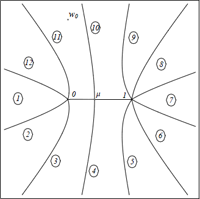 We provide an example of how the complex dynamics of a recently introduced model can be understood via a detailed analysis of its associated Riemann surface. Thanks to this geometric description an explicit formula for the period of the orbits can be derived, which is shown to depend on the initial data and the continued fraction expansion of a simple ratio of the coupling constants of the problem. For rational values of this ratio and generic values of the initial data, all orbits are periodic and the system is isochronous. For irrational values of the ratio, there exist periodic and quasi-periodic orbits for different initial data. Moreover, the dependence of the period on the initial data shows a rich behavior and initial data can always be found such the period is arbitrarily high.
http://arxiv.org/abs/1104.2205
Chaotic Dynamics (nlin.CD); Dynamical Systems (math.DS); Exactly Solvable and Integrable Systems (nlin.SI)