S. Wimberger, C. A. Parra-Murillo, G. Kordas
A paradigm model of modern atom optics is studied, strongly interacting ultracold bosons in an optical lattice. This many-body system can be artificially opened in a controlled manner by modern experimental techniques. We present results based on a non-hermitian effective Hamiltonian whose quantum spectrum is analyzed. The direct access to the spectrum of the metastable many-body system allows us to easily identify relatively stable quantum states, corresponding to previously predicted solitonic many-body structures.
http://arxiv.org/abs/1310.5937
Pattern Formation and Solitons (nlin.PS); Quantum Gases (cond-mat.quant-gas); Quantum Physics (quant-ph)
Steffen Schmidt, S. P. Klevansky
This paper explains the systematics of the generation of families of spectra for the PT-symmetric quantum-mechanical Hamiltonians \(H=p^2+x^2(ix)^\epsilon\), \(H=p^2+(x^2)^\delta\), and \(H=p^2-(x^2)^\mu\). In addition, it contrasts the results obtained with those found for a bosonic scalar field theory, in particular in one dimension, highlighting the similarities and differences to the quantum-mechanical case. It is shown that the number of families of spectra can be deduced from the number of noncontiguous pairs of Stokes’ wedges that display PT-symmetry. To do so, simple arguments that use the WKB approximation are employed, and these imply that the eigenvalues are real. However, definitive results are in most cases presently only obtainable numerically, and not all eigenvalues in each family may be real. Within the approximations used, it is illustrated that the difference between the quantum-mechanical and the field-theoretical cases lies in the number of accessible regions in which the eigenfunctions decay exponentially. This paper reviews and implements well-known techniques in complex analysis and PT-symmetric quantum theory.
http://arxiv.org/abs/1204.4599
High Energy Physics – Theory (hep-th); Mathematical Physics (math-ph); Quantum Physics (quant-ph)
Carl M. Bender, Daniel W. Hook, S. P. Klevansky
The non-Hermitian PT-symmetric quantum-mechanical Hamiltonian \(H=p^2+x^2(ix)^\epsilon\) has real, positive, and discrete eigenvalues for all \(\epsilon\geq 0\). These eigenvalues are analytic continuations of the harmonic-oscillator eigenvalues \(E_n=2n+1\) (n=0, 1, 2, 3, …) at \(\epsilon=0\). However, the harmonic oscillator also has negative eigenvalues \(E_n=-2n-1\) (n=0, 1, 2, 3, …), and one may ask whether it is equally possible to continue analytically from these eigenvalues. It is shown in this paper that for appropriate PT-symmetric boundary conditions the Hamiltonian \(H=p^2+x^2(ix)^\epsilon\) also has real and {\it negative} discrete eigenvalues. The negative eigenvalues fall into classes labeled by the integer N (N=1, 2, 3, …). For the Nth class of eigenvalues, \(\epsilon\) lies in the range \((4N-6)/3<\epsilon<4N-2\). At the low and high ends of this range, the eigenvalues are all infinite. At the special intermediate value \(\epsilon=2N-2\) the eigenvalues are the negatives of those of the conventional Hermitian Hamiltonian \(H=p^2+x^{2N}\). However, when \(\epsilon\neq 2N-2\), there are infinitely many complex eigenvalues. Thus, while the positive-spectrum sector of the Hamiltonian \(H=p^2+x^2(ix)^\epsilon\) has an unbroken PT symmetry (the eigenvalues are all real), the negative-spectrum sector of \(H=p^2+x^2(ix)^\epsilon\) has a broken PT symmetry (only some of the eigenvalues are real).
http://arxiv.org/abs/1203.6590
High Energy Physics – Theory (hep-th); Mathematical Physics (math-ph); Quantum Physics (quant-ph)
Christian Zielinski, Qing-hai Wang
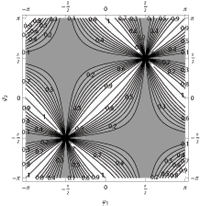 The degree of entanglement is determined for arbitrary states of a PT-symmetric bipartite composite system. We characterize the rate with which entangled states are generated and show that this rate can be quantified by a small set of parameters. These relations allow one in principle to increase the efficiency of these systems to entangle states. It is also noticed that many relations resemble corresponding ones in conventional quantum mechanics.
http://arxiv.org/abs/1106.3856
High Energy Physics – Theory (hep-th); Quantum Physics (quant-ph)
Carl M. Bender, S. P. Klevansky
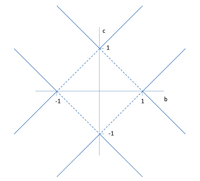 A recent paper by Jones-Smith and Mathur extends PT-symmetric quantum mechanics from bosonic systems (systems for which \(T^2=1\)) to fermionic systems (systems for which \(T^2=-1\)). The current paper shows how the formalism developed by Jones-Smith and Mathur can be used to construct PT-symmetric matrix representations for operator algebras of the form \(\eta^2=0\), \(\bar{\eta}^2=0\), \(\eta\bar{\eta}+\bar {\eta} =\alpha 1\), where \(\bar{eta}=\eta^{PT} =PT \eta T^{-1}P^{-1}\). It is easy to construct matrix representations for the Grassmann algebra (\(\alpha=0\)). However, one can only construct matrix representations for the fermionic operator algebra (\(\alpha \neq 0\)) if \(\alpha= -1\); a matrix representation does not exist for the conventional value \(\alpha=1\).
http://arxiv.org/abs/1104.4156
Subjects: High Energy Physics – Theory (hep-th); Mathematical Physics (math-ph); Quantum Physics (quant-ph)