Kumar Abhinav, Prasanta K. Panigrahi
In “Comment on Supersymmetry, PT-symmetry and spectral bifurcation” \cite{BQ1}, Bagchi and Quesne correctly show the presence of a class of states for the complex Scarf-II potential in the unbroken PT-symmetry regime, which were absent in \cite{AP}. However, in the spontaneously broken PT-symmetry case, their argument is incorrect since it fails to implement the condition for the potential to be PT-symmetric: $C^{PT}[2(A-B)+\alpha]=0$. It needs to be emphasized that in the models considered in \cite{AP}, PT is spontaneously broken, implying that the potential is PT- symmetric, whereas the ground state is not. Furthermore, our supersymmetry (SUSY)-based ‘spectral bifurcation’ holds \textit{independent} of the $sl(2)$ symmetry consideration for a large class of PT-symmetric potentials.
http://arxiv.org/abs/1010.1909
Quantum Physics (quant-ph)
H. F. Jones
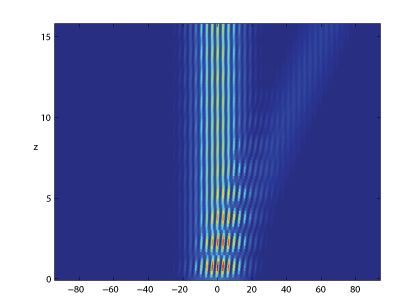
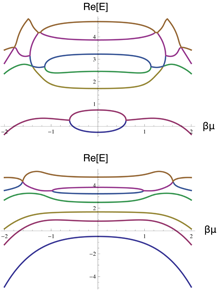
 We show how the band structure and beam dynamics of non-Hermitian $PT$-symmetric sinusoidal optical lattices can be approached from the point of view of the equivalent Hermitian problem, obtained by an analytic continuation in the transverse spatial variable $x$. In this latter problem the eigenvalue equation reduces to the Mathieu equation, whose eigenfunctions and properties have been well studied. That being the case, the beam propagation, which parallels the time-development of the wave-function in quantum mechanics, can be calculated using the equivalent of the method of stationary states. We also discuss a model potential that interpolates between a sinusoidal and periodic square well potential, showing that some of the striking properties of the sinusoidal potential, in particular birefringence, become much less prominent as one goes away from the sinusoidal case.
http://arxiv.org/abs/1009.5784
Optics (physics.optics); Quantum Physics (quant-ph)
R.A. Pimenta, M.J. Martins
We study the solutions of the Yang-Baxter equation associated to nineteen vertex models invariant by the parity-time symmetry from the perspective of algebraic geometry. We determine the form of the algebraic curves constraining the respective Boltzmann weights and found that they possess a universal structure. This allows us to classify the integrable manifolds in four different families reproducing three known models besides uncovering a novel nineteen vertex model in a unified way. The introduction of the spectral parameter on the weights is made via the parameterization of the fundamental algebraic curve which is a conic. The diagonalization of the transfer matrix of the new vertex model and its thermodynamic limit properties are discussed. We point out a connection between the form of the main curve and the nature of the excitations of the corresponding spin-1 chains.
http://arxiv.org/abs/1010.1274
Mathematical Physics (math-ph)
Andrey A. Sukhorukov, Zhiyong Xu, Yuri S. Kivshar
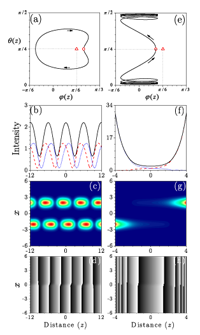 We reveal a generic connection between the effect of time-reversals and nonlinear wave dynamics in systems with parity-time (PT) symmetry, considering a symmetric optical coupler with balanced gain and loss where these effects can be readily observed experimentally. We show that for intensities below a threshold level, the amplitudes oscillate between the waveguides, and the effects of gain and loss are exactly compensated after each period due to {periodic time-reversals}. For intensities above a threshold level, nonlinearity suppresses periodic time-reversals leading to the symmetry breaking and a sharp beam switching to the waveguide with gain. Another nontrivial consequence of linear PT-symmetry is that the threshold intensity remains the same when the input intensities at waveguides with loss and gain are exchanged.
http://arxiv.org/abs/1009.5428
Optics (physics.optics)
O. Cherbal, M. Drir, M. Maamache, D.A. Trifonov
A new class of non-Hermitian Hamiltonians with real spectrum, which are written as a real linear combination of su(2) generators is analyzed. The metric which allows the transition to the equivalent Hermitian Hamiltonian is established. A pseudo-Hermitian supersymmetic extension of such Hamiltonians is performed, which correspond to the pseudo-Hermitian supersymmetric system of the boson-phermion oscillator. We extend the supercoherent states formalism to such supersymmetic systems via the pseudo-unitary supersymmetric displacement operator method. The constructed family of these supercoherent states consists of two dual subfamilies that form a bi-overcomplete and bi-normal system in the boson-phermion Fock space. The states of each subfamily are eigenvectors of the boson annihilation operator and of one of the two phermion lowering operators.
http://arxiv.org/abs/1009.5293
Quantum Physics (quant-ph)
Zhenya Yan, Bo Xiong, Wu-Ming Liu
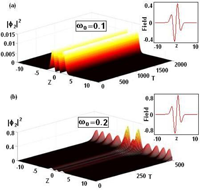 We report explicitly a novel family of exact PT-symmetric solitons and further study their spontaneous PT symmetry breaking, stabilities and collisions in Bose-Einstein condensates trapped in a PT-symmetric harmonic trap and a Hermite-Gaussian gain/loss potential. We observe the significant effects of mean-field interaction by modifying the threshold point of spontaneous PT symmetry breaking in Bose-Einstein condensates. Our scenario provides a promising approach to study PT-related universal behaviors in non-Hermitian quantum system based on the manipulation of gain/loss potential in Bose-Einstein condensates.
http://arxiv.org/abs/1009.4023
Quantum Gases (cond-mat.quant-gas)
Carl M. Bender, R. J. Kalveks
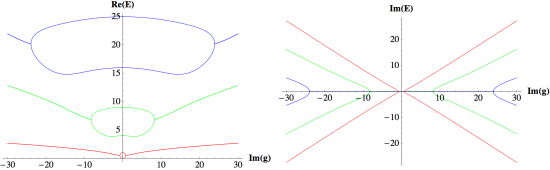
The E2 algebra has three elements, J, u, and v, which satisfy the commutation relations [u,J]=iv, [v,J]=-iu, [u,v]=0. We can construct the Hamiltonian H=J^2+gu, where g is a real parameter, from these elements. This Hamiltonian is Hermitian and consequently it has real eigenvalues. However, we can also construct the PT-symmetric and non-Hermitian Hamiltonian H=J^2+igu, where again g is real. As in the case of PT-symmetric Hamiltonians constructed from the elements x and p of the Heisenberg algebra, there are two regions in parameter space for this PT-symmetric Hamiltonian, a region of unbroken PT symmetry in which all the eigenvalues are real and a region of broken PT symmetry in which some of the eigenvalues are complex. The two regions are separated by a critical value of g.
http://arxiv.org/abs/1009.3236
High Energy Physics – Theory (hep-th); Mathematical Physics (math-ph); Quantum Physics (quant-ph)
Peter N. Meisinger, Michael C. Ogilvie, Timothy D. Wiser
 Generalized PT symmetry provides crucial insight into the sign problem for two classes of models. In the case of quantum statistical models at non-zero chemical potential, the free energy density is directly related to the ground state energy of a non-Hermitian, but generalized PT-symmetric Hamiltonian. There is a corresponding class of PT-symmetric classical statistical mechanics models with non-Hermitian transfer matrices. For both quantum and classical models, the class of models with generalized PT symmetry is precisely the class where the complex weight problem can be reduced to real weights, i.e., a sign problem. The spatial two-point functions of such models can exhibit three different behaviors: exponential decay, oscillatory decay, and periodic behavior. The latter two regions are associated with PT symmetry breaking, where a Hamiltonian or transfer matrix has complex conjugate pairs of eigenvalues. The transition to a spatially modulated phase is associated with PT symmetry breaking of the ground state, and is generically a first-order transition. In the region where PT symmetry is unbroken, the sign problem can always be solved in principle. Moreover, there are models with PT symmetry which can be simulated for all parameter values, including cases where PT symmetry is broken.
http://arxiv.org/abs/1009.0745
High Energy Physics – Theory (hep-th)
Keiichi Nagao and Holger Bech Nielsen
We study the Hamiltonian that is not at first hermitian. Requirement that a measurement shall not change one Hamiltonian eigenstate into another one with a different eigenvalue imposes that an inner product must be defined so as to make the Hamiltonian normal with regard to it. After a long time development with the non-hermitian Hamiltonian, only a subspace of possible states will effectively survive. On this subspace the effect of the anti-hermitian part of the Hamiltonian is suppressed, and the Hamiltonian becomes hermitian. Thus hermiticity emerges automatically, and we have no reason to maintain that at the fundamental level the Hamiltonian should be hermitian. We also point out a possible misestimation of a past state by extrapolating back in time with the hermitian Hamiltonian. It is a seeming past state, not a true one.
http://arxiv.org/abs/1009.0441
Quantum Physics (quant-ph); High Energy Physics – Theory (hep-th); General Physics (physics.gen-ph)