Miloslav Znojil
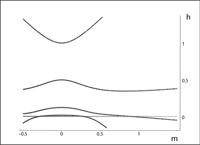 The one-dimensional real line of coordinates is replaced, for simplification or approximation purposes, by an N-plet of the so called Gauss-Hermite grid points. These grid points are interpreted as the eigenvalues of a tridiagonal matrix \(\mathfrak{q}_0\) which proves rather complicated. Via the “zeroth” Dyson-map \(\Omega_0\) the “operator of position” \(\mathfrak{q}_0\) is then further simplified into an isospectral matrix \(Q_0\) which is found optimal for the purpose. As long as the latter matrix appears non-Hermitian it is not an observable in the manifestly “false” Hilbert space \({\cal H}^{(F)}:=\mathbb{R}^N\). For this reason the optimal operator \(Q_0\) is assigned the family of its isospectral avatars \(\mathfrak{h}_\alpha\), \(\alpha=(0,)\,1,2,…\). They are, by construction, selfadjoint in the respective \(\alpha-\)dependent image Hilbert spaces \({\cal H}^{(P)}_\alpha\) obtained from \({\cal H}^{(F)}\) by the respective “new” Dyson maps \(\Omega_\alpha\). In the ultimate step of simplification, the inner product in the F-superscripted space is redefined in an {\it ad hoc}, $\alpha-$dependent manner. The resulting “simplest”, S-superscripted representations \({\cal H}^{(S)}_\alpha\) of the eligible physical Hilbert spaces of states (offering different dynamics) then emerge as, by construction, unitary equivalent to the (i.e., indistinguishable from the) respective awkward, P-superscripted and \(\alpha-\)subscripted physical Hilbert spaces.
http://arxiv.org/abs/1107.1770
Quantum Physics (quant-ph); Mathematical Physics (math-ph)
Ali Mostafazadeh
Using the Pais-Uhlenbeck Oscillator as a toy model, we outline a consistent alternative to the indefinite-metric quantization scheme that does not violate unitarity. We describe the basic mathematical structure of this method by giving an explicit construction of the Hilbert space of state vectors and the corresponding creation and annihilation operators. The latter satisfy the usual bosonic commutation relation and differ from those of the indefinite-metric theories by a sign in the definition of the creation operator. This change of sign achieves a definitization of the indefinite-metric that gives life to the ghost states without changing their contribution to the energy spectrum.
http://arxiv.org/abs/1107.1874
High Energy Physics – Theory (hep-th); General Relativity and Quantum Cosmology (gr-qc); Mathematical Physics (math-ph); Quantum Physics (quant-ph)
Kenta Esaki, Masatoshi Sato, Kazuki Hasebe, Mahito Kohmoto
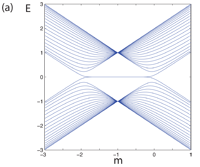
 Topological stability of the edge states is investigated for non-Hermitian systems. We examine two classes of non-Hermitian Hamiltonians supporting real bulk eigenenergies in weak non-Hermiticity: SU(1,1) and SO(3,2) Hamiltonians. As an SU(1,1) Hamiltonian, the tight-binding model on the honeycomb lattice with imaginary on-site potentials is examined. Edge states with ReE=0 and their topological stability are discussed by the winding number and the index theorem, based on the pseudo-anti-Hermiticity of the system. As a higher symmetric generalization of SU(1,1) Hamiltonians, we also consider SO(3,2) models. We investigate non-Hermitian generalization of the Luttinger Hamiltonian on the square lattice, and that of the Kane-Mele model on the honeycomb lattice, respectively. Using the generalized Kramers theorem for the time-reversal operator Theta with Theta^2=+1 [M. Sato et al., arXiv:1106.1806], we introduce a time-reversal invariant Chern number from which topological stability of gapless edge modes is argued.
http://arxiv.org/abs/1107.2079
Mesoscale and Nanoscale Physics (cond-mat.mes-hall); Other Condensed Matter (cond-mat.other)
Ali Mostafazadeh
 We study the problem of locating spectral singularities of a general complex point interaction with a support at a single point. We also determine the bound states, examine the special cases where the point interaction is P-, T-, and PT-symmetric, and explore the issue of the coalescence of spectral singularities and bound states.
http://arxiv.org/abs/1107.1875
Mathematical Physics (math-ph); Quantum Physics (quant-ph)
Yi Chen Hu, Taylor L. Hughes
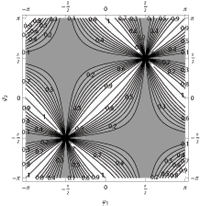
 In this work we consider a generalization of the symmetry classification of topological insulators to non-Hermitian Hamiltonians which satisfy a combined PT-symmetry (parity and time-reversal). We show via examples, and explicit bulk and boundary state proofs that the typical paradigm of forming topological insulator states from Dirac Hamiltonians is not compatible with the construction of non-Hermitian PT-symmetric Hamiltonians. The topological insulator states are PT-breaking phases and have energy spectra which are complex (not real) and thus such non-Hermitian Hamiltonians are not consistent quantum theories.
http://arxiv.org/abs/1107.1064
Other Condensed Matter (cond-mat.other); Quantum Physics (quant-ph)
Carl M. Bender, Philip D. Mannheim
In nonrelativistic quantum mechanics and in relativistic quantum field theory, time t is a parameter and thus the time-reversal operator T does not actually reverse the sign of t. However, in relativistic quantum mechanics the time coordinate t and the space coordinates x are treated on an equal footing and all are operators. In this paper it is shown how to extend PT symmetry from nonrelativistic to relativistic quantum mechanics by implementing time reversal as an operation that changes the sign of the time coordinate operator t. Some illustrative relativistic quantum-mechanical models are constructed whose associated Hamiltonians are non-Hermitian but PT symmetric, and it is shown that for each such Hamiltonian the energy eigenvalues are all real.
http://arxiv.org/abs/1107.0501
High Energy Physics – Theory (hep-th); Mathematical Physics (math-ph); Quantum Physics (quant-ph)
Jose Reslen
 We study the effect of inter-band interactions in the absorption profile of a semi-classical model describing electromagnetically induced transparency. We develop a consistent approach using a nonhermitian Hamiltonian to model particle decay. This allow us to characterize the system response for different number of particles so that the effect of particle-interaction on the transmission profile can be studied over a wide range of characteristic parameters.
http://arxiv.org/abs/1106.5240
Quantum Physics (quant-ph)
Hiroshi Miki, Luc Vinet, Alexei Zhedanov
A set of \(r\) non-Hermitian oscillator Hamiltonians in \(r\) dimensions is shown to be simultaneously diagonalizable. Their spectra is real and the common eigenstates are expressed in terms of multiple Charlier polynomials. An algebraic interpretation of these polynomials is thus achieved and the model is used to derive some of their properties.
http://arxiv.org/abs/1106.5243
Mathematical Physics (math-ph)
Michael H. Freedman, Jan Gukelberger, Matthew B. Hastings, Simon Trebst, Matthias Troyer, Zhenghan Wang
 Galois conjugation relates unitary conformal field theories (CFTs) and topological quantum field theories (TQFTs) to their non-unitary counterparts. Here we investigate Galois conjugates of quantum double models, such as the Levin-Wen model. While these Galois conjugated Hamiltonians are typically non-Hermitian, we find that their ground state wave functions still obey a generalized version of the usual code property (local operators do not act on the ground state manifold) and hence enjoy a generalized topological protection. The key question addressed in this paper is whether such non-unitary topological phases can also appear as the ground states of Hermitian Hamiltonians. Specific attempts at constructing Hermitian Hamiltonians with these ground states lead to a loss of the code property and topological protection of the degenerate ground states. Beyond this we rigorously prove that no local change of basis can transform the ground states of the Galois conjugated doubled Fibonacci theory into the ground states of a topological model whose Hermitian Hamiltonian satisfies Lieb-Robinson bounds. These include all gapped local or quasi-local Hamiltonians. A similar statement holds for many other non-unitary TQFTs. One consequence is that the “Gaffnian” wave function cannot be the ground state of a gapped fractional quantum Hall state.
http://arxiv.org/abs/1106.3267
Strongly Correlated Electrons (cond-mat.str-el); Mesoscale and Nanoscale Physics (cond-mat.mes-hall); Mathematical Physics (math-ph)
Christian Zielinski, Qing-hai Wang
 The degree of entanglement is determined for arbitrary states of a PT-symmetric bipartite composite system. We characterize the rate with which entangled states are generated and show that this rate can be quantified by a small set of parameters. These relations allow one in principle to increase the efficiency of these systems to entangle states. It is also noticed that many relations resemble corresponding ones in conventional quantum mechanics.
http://arxiv.org/abs/1106.3856
High Energy Physics – Theory (hep-th); Quantum Physics (quant-ph)